Featured · · 3 min read
Business Owners: How Proper Income Structuring Can Increase Your Home Loan Eligibility
Many business owners assume that their latest Notice of Assessment (NOA) determines how much they can borrow for a property purchase.
In reality, two borrowers earning the same amount can receive vastly different loan outcomes depending on how their income is structured.
We've seen cases where proper income structuring increased home loan eligibility by more than $300,000 without the borrower earning a single dollar more.
If you're a business owner planning to buy property in Singapore, understanding how banks assess income could make a significant difference to your borrowing power.
Why Business Owners Often Receive Lower Loan Assessments
When assessing a home loan application, banks generally prefer income that is stable, predictable and easy to verify.
For salaried employees, this is relatively straightforward. Monthly salary credits and CPF contributions provide a clear picture of income consistency.
Business owners, however, are often assessed differently.
Many banks may assess business owners based on their NOA, and in some cases only recognise around 70% of the declared income.
Example
A salaried employee earning $10,000 per month may have close to 100% of that income recognised.
A business owner generating the same amount of income may have a lower recognised income for loan assessment purposes.
This difference can significantly reduce borrowing capacity.
Real Example: Same Income, Different Loan Outcome
Let's look at a simplified example.
Scenario 1: NOA-Based Assessment
A business owner has:
- Age: 30
- Annual Income: $120,000
- Assessed primarily based on NOA
Maximum Loan Eligibility:
$785,479
Scenario 2: Salary-Based Assessment
The same borrower structures income more effectively through:
- Regular salary crediting
- CPF contributions
- Consistent income records
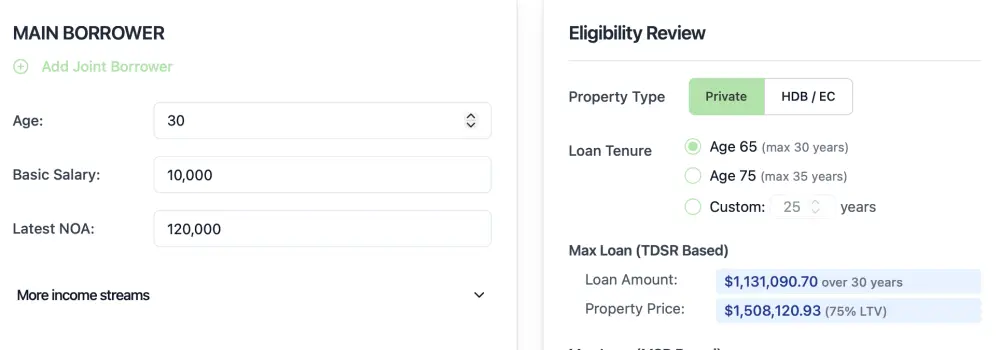
Maximum Loan Eligibility:
$1,131,091
The Difference? More Than $345,000
In this example:
$1,131,091 - $785,479
= $345,612
That's more than $345,000 in additional loan eligibility.
The borrower did not increase revenue.
The borrower did not work longer hours.
The borrower simply ensured that their income was presented in a way that banks could assess more favourably.
What Is Income Structuring?
Income structuring refers to creating a more bank-friendly income profile before applying for a home loan.
Depending on your situation, this may involve:
- Salary crediting into your personal account
- CPF contributions
- Maintaining consistency over time
- Proper documentation of income
The objective is not to artificially inflate income.
Instead, it is to ensure your actual earning capacity is properly recognised during the bank's assessment.
Why Timing Matters
One of the biggest mistakes borrowers make is waiting until they have already found a property before reviewing their loan eligibility.
Income structuring takes time.
Most banks want to see a track record of consistency before recognising the revised income structure.
As a general guideline:
- Income structuring should begin at least 3–6 months before purchase
- IPA should ideally be obtained before viewing properties
- Planning early provides more flexibility and more financing options
Waiting until the last minute may leave significant borrowing power on the table.
The Bigger Picture
Most people believe their home loan eligibility is fixed.
It isn't.
Your loan eligibility is influenced by several factors, including:
- Income
- Liabilities
- Rental income
- Asset position
- Bank selection
Income structuring is simply one of the most powerful levers available to business owners.
Complimentary Loan Eligibility Review
Thinking of purchasing a property within the next 6–12 months?
We can help you understand:
- How banks are likely to assess your income
- Whether your current structure is optimised
- Your potential maximum loan eligibility
📲 Contact us for a complimentary loan eligibility review and personalised assessment.
Written by Loan Experts. General information, not personal advice.